
Service
Garage Door Roller Replacement for Carrollton Homes
Worn rollers and bent stems are common on Carrollton's 1980s-era garage doors once cold winter weather sets in. Here's why, and when to replace them well.
- Licensed & Insured
- Same-Area Service Calls
- Upfront Pricing
What Happens When You Call
-
1
Call or Request a Quote
Tell us what the door is doing and roughly how old the house is - that alone points us toward the likely part before a truck leaves.
-
2
On-Site Diagnosis
A tech checks the spring, cables, tracks, and opener in person and tells you plainly what is actually wrong.
-
3
Straight Price, No Surprises
You get a number before any work starts. It covers parts and labor, nothing added after the fact.
-
4
Fixed the Same Visit
Most repairs are done in one trip. If a part needs sourcing, we tell you that upfront instead of guessing.
Why It Happens Here
Most houses across this service area went up between 1967 and 2003, with the median sitting around 1980. That's true across all eleven towns we work in, not just Carrollton proper, and it matters for rollers because a door built in that window either still runs its original steel rollers on steel track or got a single nylon swap sometime in the 90s. Either way, that hardware has had thirty to fifty years to wear.
Steel rollers wear at the axle first - the stem thins, the wheel starts to wobble in the track, and the door starts fighting itself on every open and close. Nylon rollers from a 90s upgrade wear differently: the nylon face cracks and flakes, especially once it's been through enough freeze-thaw cycles.
The climate here is cold moderate, not brutal, but it's enough. Grease inside an old roller stem thickens on the first sub-freezing mornings of the season, and a stem that's already worn thin from decades of use doesn't roll through that resistance - it bends. That's the failure we see spike every year once the weather turns, on doors that were fine all fall.
Across the 14,567 households in this area, with roughly 8,079 of those owner-occupied houses, a large share sit right in that 1967-2003 window. It's not a rare problem. It's the ordinary result of an ordinary house getting older.
How It Shows Up
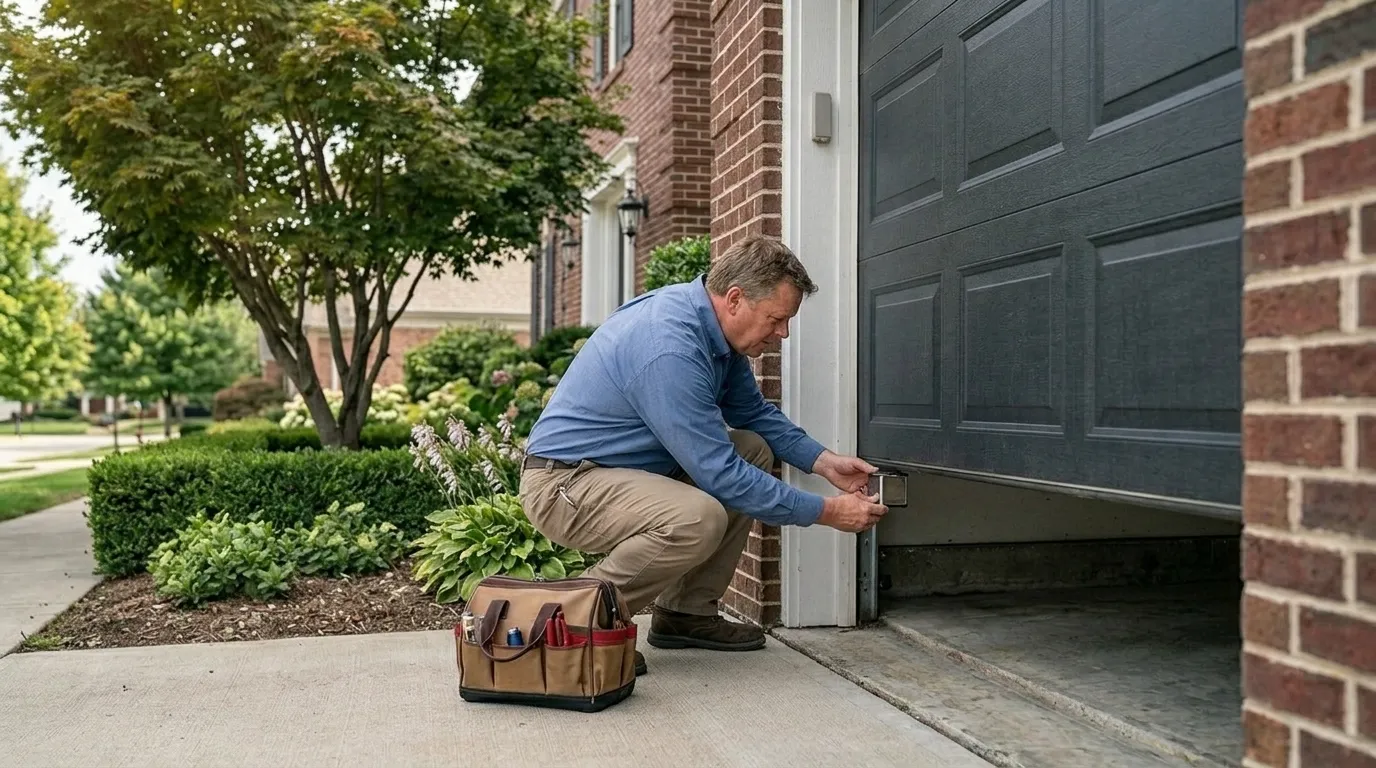
The earliest sign is sound, not motion. A grinding or squealing on the way up or down usually means a roller is riding metal-on-metal instead of turning smoothly - the bearing or nylon face is gone and the stem itself is dragging in the track.
Next comes the visual tell: the door starts to hop or jump slightly as it crosses the curved section of track near the top of the opening. That's a roller that's worn enough to bind for a moment, then release. Left alone, that jumping wears a groove into the track itself, which turns a $10 part into a track replacement.
Some owners notice it as an uneven door - one side seems to travel slower than the other, or the door racks slightly and doesn't sit flat on the floor when closed. That's usually not the opener struggling; it's rollers on one side wearing faster than the other, often the side that gets more sun and more temperature swing through the day.
A gap along the bottom seal that wasn't there last year, letting in a draft where none existed, often traces back to the same worn rollers letting the door sit slightly crooked in its track. None of these show up overnight - they build over a season, which is why most calls come in clustered around the first real cold spell.
Can You Do This Yourself
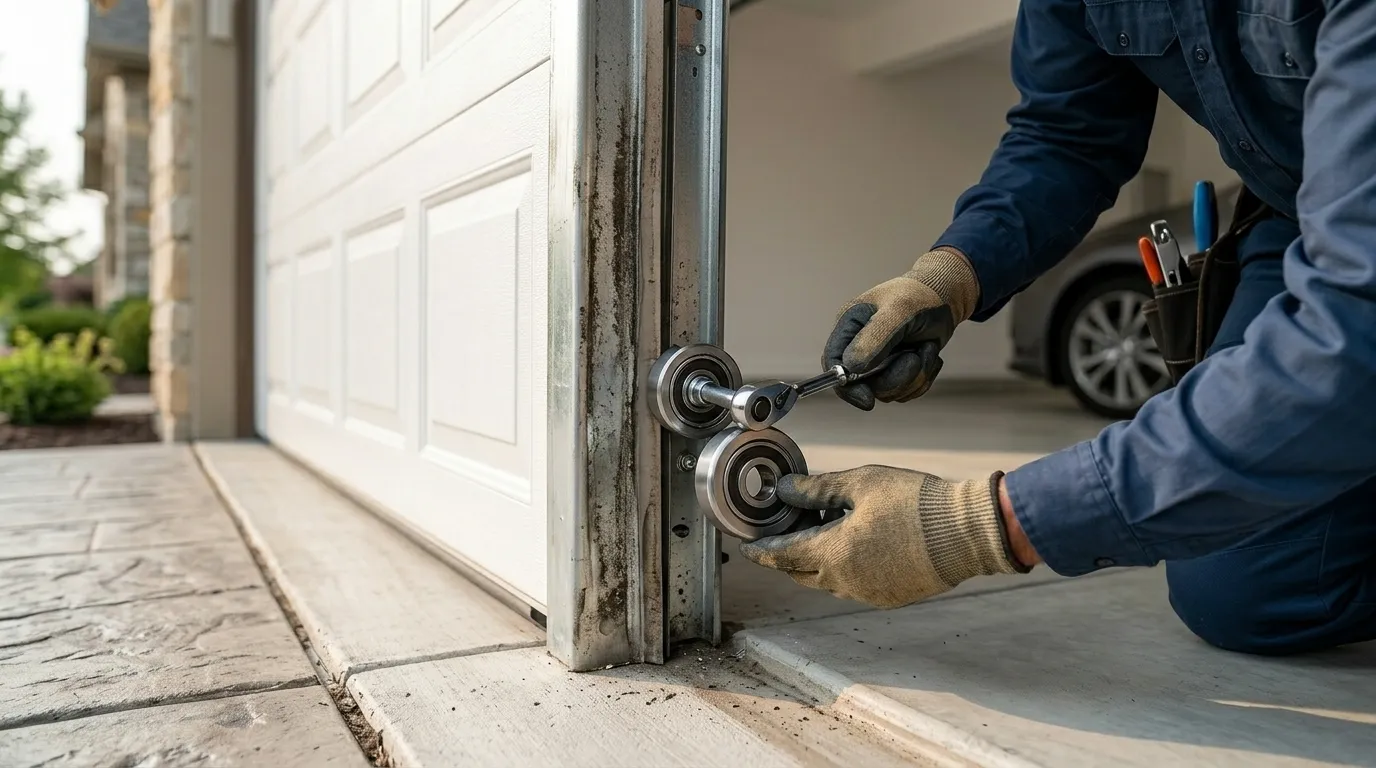
Replacing a set of nylon rollers on a door with no spring problems and a straight track is genuinely a job a handy owner can do on a Saturday. The rollers themselves aren't expensive and the swap doesn't require touching anything under tension - you're pulling a bent-track retainer or removing a hinge bolt, sliding the old roller out, and sliding the new one in.
We'll be straight about where that stops being true. If the door in question is original 1970s-1980s steel rollers on a torsion spring system, you're now working within a foot of a spring that's been under load for decades.
That spring doesn't care if you meant to leave it alone - it can let go while you're working nearby. That's not a roller job anymore, that's a spring job that happens to also need rollers, and it's not a DIY afternoon.
There's also the track question. If the bottom section of track has already worn a groove from a failing roller, swapping the roller alone won't fix the jump - the track needs straightening or replacing too, and that's a two-person job with the right clamps.
Honest answer: rollers alone, yes, go ahead. Rollers plus anything else on a door this old, call it in first.
Where This Job Goes Sideways
The most common mistake is replacing rollers on one side and assuming the other side matches. On houses from this era, the two sides often don't wear evenly - one gets more sun, more temperature swing, more use if it's the side nearer a walk-through door - so a single-side swap leaves a mismatch that shows up as racking within a few months.
The second is buying rollers sized for a modern door when the house has original 1980s-era track. Roller stem length and wheel diameter weren't fully standardized across that build era the way they are now, and a roller that's slightly wrong for the track will bind exactly the way the worn one did, just faster.
The third, and the one that costs the most, is treating the roller as the whole story when a bent stem has already scored the track. At that point, new rollers ride in a damaged channel and wear out again within a season, and the owner ends up paying for rollers twice before anyone addresses the track.
And if the door is already fighting a fatigued spring on top of worn rollers - not unusual on a house pushing forty or fifty years old - fixing rollers without touching the spring just moves the failure point, it doesn't remove it.
Talk to a Technician Before You Book
Describe what the door is doing and get a straight answer on what it likely needs.
Jobs Like Yours
Recent work from this service line.
Why Carrollton Calls Us
Frequently Asked Questions
Why do my garage door rollers wear out faster once winter hits?
In a cold moderate climate like this one, grease inside the roller stem thickens on the first sub-freezing mornings. A stem that's already thin from years of use doesn't turn through that added resistance smoothly - it bends or seizes. That's why roller calls cluster right after the first real cold spell each year, on doors that ran fine all fall.
How do I know if it's the rollers and not the opener?
Grinding or squealing during travel, the door hopping slightly near the top of the track, or one side sitting lower than the other when closed all point to rollers, not the opener. The opener motor usually keeps running smoothly even as rollers fail - it's just fighting more resistance to do the same job.
Can I replace just the worn rollers and leave the rest alone?
If the door has no spring issue and the track is still straight, yes - nylon roller replacement on its own is a reasonable job. But on houses from the 1967-2003 stock common here, a worn roller has often already scored the track, and replacing the roller alone won't stop the jumping if the channel itself is damaged.
Are nylon rollers worth the upgrade from steel?
For most owners here, yes. Nylon rollers run quieter and don't need the same lubrication schedule steel does, which matters once cold weather thickens grease on old steel stems. They cost a little more up front but hold up better through the freeze-thaw swings this area gets each winter.
Need Garage Door Roller Replacement for Carrollton Homes?
Call now for straight answers on cost and timing.